China vs U.S.: The 2026 AI Race
Chinese AI companies are challenging US dominance — here’s the latest update.
Introduction
Chinese AI companies are rapidly challenging US dominance in specific areas, particularly in open-source models and cost efficiency. However, American firms retain leads in frontier capabilities and funding. Despite US chip restrictions, recent 2026 developments show China narrowing the gap through innovative approaches.
Key Strengths of Chinese AI
- Models like DeepSeek and Alibaba's Qwen match or exceed US rivals in tasks like text generation.
- High global popularity, especially in Europe and Asia.
- Algorithmic efficiency and robotics integration give China a lead in physical-world AI applications.
- Open models lead in user adoption and deployment speed.
- Cost-effective performance allows faster global adoption.
US Advantages Persist
- Dominance in advanced chips via Nvidia and massive data centers.
- Closed models from OpenAI, Google, and Anthropic outperform overall, backed by strong funding.
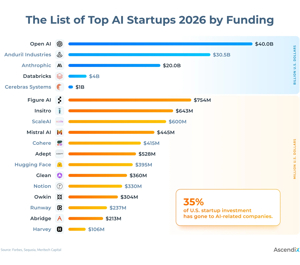
- US startups like Anthropic have $183B valuations vs China's $3–5B.
China vs US: AI Comparison Table
| Aspect | Chinese AI Lead | US AI Lead |
|---|---|---|
| Open Models | Capabilities, cost, global adoption | - |
| Closed/Frontier Models | - | Performance, downloads (~70% share) |
| Funding/Scale | - | Hyperscalers (~63% global cloud), valuations |
| Hardware | Efficiency despite restrictions | Chips, data centers |
| Applications | Robotics, rapid deployment | Software automation |
Recent 2026 Trends
- Early 2026 analysts warn of a potential "tech shock" from China's AI surge.
- US software investments maintain lead in raw computational power.
- Beijing meetings highlight funding constraints but optimism in open ecosystems.
- China aims for diverse AI governance leadership globally.
Key Follow-Ups
- What specific advantages do Chinese AI models have in cost and performance?
- How are US chip export restrictions affecting Chinese AI progress?
- Which Chinese AI companies lead in robotics applications?
- What are the latest performance benchmarks (Stanford HAI 2026)?
- Predictions for AI race outcome by 2030 (Eric Schmidt)

0 Comments